
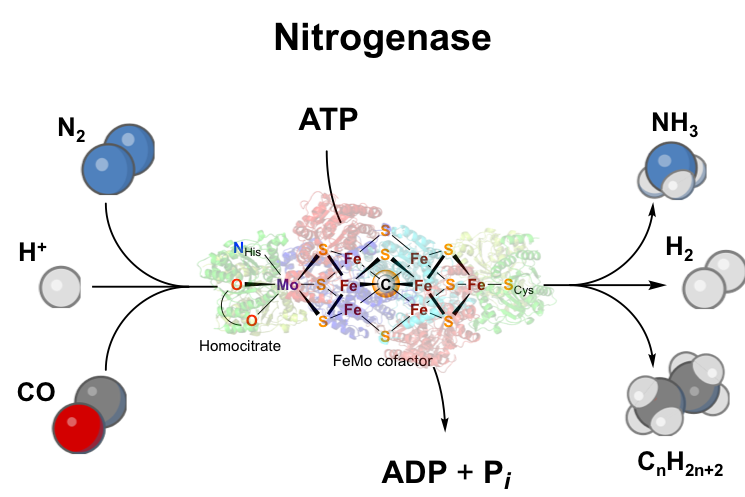
Our research interests lie within the broad themes of alternative energy solutions and sustainability. In particular, we are inspired by biological systems like nitrogenase, an enzyme capable of pulling dinitrogen from the air and converting it into ammonia. In addition to ammonia synthesis, some nitrogenase variants have also been found to be competent catalysts for the reductive coupling of carbon monoxide to yield hydrocarbon products, reminiscent of liquid fuels chemistry. In contrast to industrial processes like Fischer-Tropsch and Haber-Bosch that operate at high temperatures and pressures, nitrogenase functions under ambient conditions— near room temperature and under one atmosphere of pressure. We want to better understand how nitrogenase facilitates these challenging chemical transformations under such mild conditions.
To tackle these questions, we are developing new molecular carbon-atom sources to facilitate synthesis of iron-sulfur-carbide clusters as models of the nitrogenase active site. We will investigate these model complexes using a combination of spectroscopic (EPR, Mossbauer, X-ray) and computational methods to probe the nature of the metal-carbide bonding interactions, their effect on the cluster electronic structure, and potential implications for nitrogenase reactivity.
In addition to nitrogenase models, we are exploring the application of our molecular carbon-atom sources toward the synthesis of other novel metal-carbon complexes—such as terminal iron carbides as models of Fischer-Tropsch intermediates— as well as their potential for organic and main-group transformations
Check back in for updates soon!
Related publications:
C. Van Stappen, L. Decamps, G.E. Cutsail III, R. Bjornsson, J.T. Henthorn, J. Birrell, S. DeBeer, The Spectroscopy of Nitrogenases, Chem. Rev., 2020, 120(12), 5005-5081, DOI: 10.1021/acs.chemrev.9b00650
J.T. Henthorn, R.J. Arias, S. Koroidov, T. Kroll, D. Sokaras, U. Bergmann, D.C. Rees, and S. DeBeer, Localized Electronic Structure of Nitrogenase FeMoco Revealed by Selenium K-Edge High Resolution X-ray Absorption Spectroscopy, J. Am. Chem. Soc., 2019, 141(34), 13676–13688, DOI: 10.1021/jacs.9b06988
J.T. Henthorn, G.E. Cutsail III, T. Weyhermüller, and S. DeBeer, Stabilization of Intermediate Spin States in Mixed-valent Diiron Dichalcogenide Complexes, Nat. Chem., 2022, 14, 328-333, DOI:10.1038/s41557-021-00853-5
 Henthorn Research